

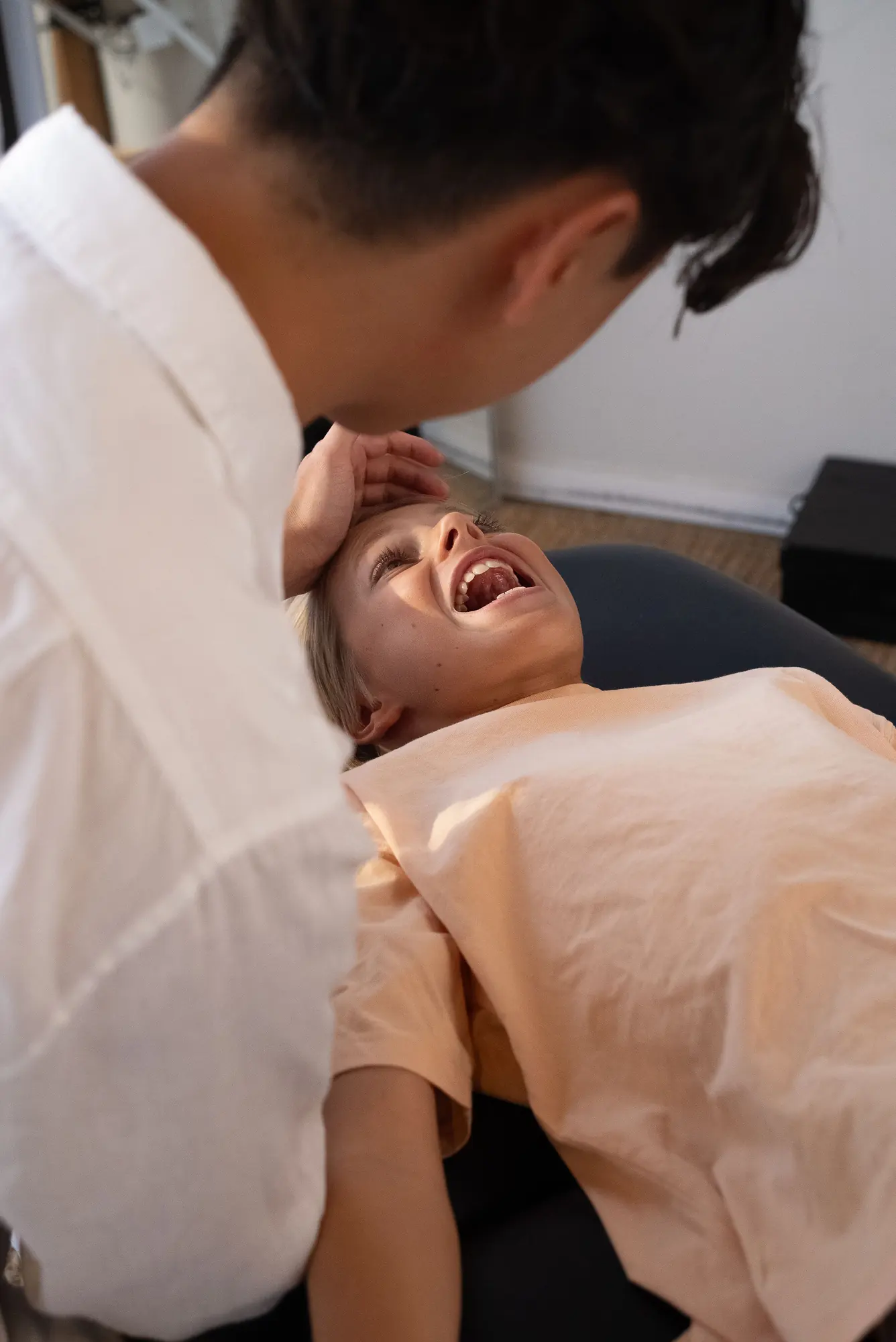
What myofunctional therapy is
"Orofacial" means the mouth and face, and "myofunctional" means how muscles work. Orofacial myofunctional therapy looks at the everyday habits of the tongue, lips, cheeks and jaw: how they rest when you are not thinking about them, and how they move when you breathe, chew, swallow and speak.
Through a program of exercises, we work towards:
- Breathing through the nose at rest
- The tongue resting gently against the roof of the mouth
- Lips that close comfortably at rest
- Swallowing without the tongue pushing forward against the teeth
- A relaxed jaw, and chewing on both sides
You can have myofunctional therapy on its own, or alongside your chiropractic care when jaw, neck and posture are part of the picture.
Most of the work happens at home. Myofunctional therapy is exercise-based, so every program is built around short daily practice that fits into your routine, with regular reviews in clinic to check progress and move you to the next step.
Who it can help
People usually come to us because they, their dentist or their orthodontist have noticed how the tongue, lips or jaw are resting or moving. Every program starts with an assessment, so you know exactly what we find before any exercises begin.
Children
- Mouth breathing, or lips that rest apart
- A tongue that rests low or pushes forward when swallowing (tongue thrust)
- Tongue tie, with support before and after a release
- Thumb sucking or dummy habits continuing past the toddler years
- Messy or slow eating, or chewing mostly on one side
- Snoring or restless sleep
- Support alongside orthodontic treatment such as a plate, expander or braces
We see children for active therapy from around 3 to 4 years of age, once they can follow and practise simple exercises at home. For toddlers, we can start with an assessment, guidance for parents and a few simple exercises to support their development. For babies, we support feeding and tongue-tie care alongside your lactation consultant (IBCLC), GP or paediatrician through our care for babies and kids.
Adults
- Jaw tension, clenching and TMJ discomfort
- Mouth breathing habits and low tongue posture
- Tongue thrust or a swallowing pattern that has continued from childhood
- Snoring
- Support before, during or after orthodontic treatment, including clear aligners
What an assessment involves
Every program follows the same five steps, adapted to your age and goals.
Listen
We hear what you, your dentist or your orthodontist have noticed, and take a full history of breathing, sleep, eating, dental and orthodontic care. Please bring any reports you have.
Assess
We gently check how you breathe at rest, where your tongue and lips rest, how freely your tongue moves, how you chew and swallow, and your head and neck posture.
Explain
What we found, what we suggest, how long the program is likely to take and what it costs. Then you decide.
Practise
We teach each exercise in clinic until it feels easy, then give you clear instructions to practise at home each day.
Review
Regular reviews to check your progress against your goals, refine each exercise and add the next ones, with visits spaced out as you progress.
Bringing a child? A parent or carer stays in the room for every appointment. Exercises are playful and built for their age, and we show you how to help at home.
Fees: a myofunctional assessment is TBC and a review appointment is TBC. See fees and health funds.
How it fits with your other care
Myofunctional therapy sits alongside the care you already have. With your permission, we share our findings with your other practitioners so everyone works from the same plan.
- Dentists
Your dentist often notices the first signs, such as mouth breathing, tongue thrust or clenching. We work alongside them and keep them updated.
- Orthodontists
We plan your exercises around your orthodontic treatment, whether that is a plate, an expander, braces or clear aligners.
- Speech pathologists
Speech is their area. Where tongue posture and swallowing overlap with speech, we work alongside them so the exercises support each other.
- Bodywork and chiropractic care
Because Daniel is also a chiropractor, your jaw, neck and posture can be assessed and cared for in the same plan. That can include gentle bodywork for the jaw, neck, diaphragm and posture, including the deep front line, a chain of fascia (connective tissue) often described as linking the tongue and jaw with the neck, diaphragm and core.
About bodywork
For babies and children, we also work alongside lactation consultants, GPs and paediatricians. If more is needed, we refer to whoever is needed, based on our assessment.
Questions about myofunctional therapy
What is orofacial myofunctional therapy?
It is a program of gentle, targeted exercises that retrains how the tongue, lips and jaw rest and move. It looks at how you breathe at rest, where your tongue sits, whether your lips close comfortably, and how you chew and swallow.
Is myofunctional therapy for children or adults?
Both. We see children once they can follow and practise simple exercises at home, and adults of any age. Exercises are adapted to each person, and for children they are playful and built around family life.
What happens at a myofunctional assessment?
We take a full history, then gently check how you breathe at rest, where your tongue and lips rest, how freely your tongue moves, and how you chew and swallow. We explain what we find, what we suggest and what it costs before any exercises start.
How long does a myofunctional therapy program take?
It depends on what we find at your assessment and how regularly the exercises are practised at home. You get a written plan with a clear timeline after your assessment, and we review your progress together at set points.
Can myofunctional therapy be done alongside braces or a plate?
Yes. We work alongside your dentist or orthodontist and plan your exercises around your orthodontic treatment, whether you are about to start, part way through or finished.
Do I need a referral for myofunctional therapy?
No. You can book a myofunctional assessment directly online or by phone. If your dentist, orthodontist or speech pathologist has suggested it, please bring any reports you have.
How much does myofunctional therapy cost?
A myofunctional assessment is TBC and a review appointment is TBC. You get the full cost of your plan before you start.